
Online casinos that accept SMS deposits: Boku explained
 Available in GB
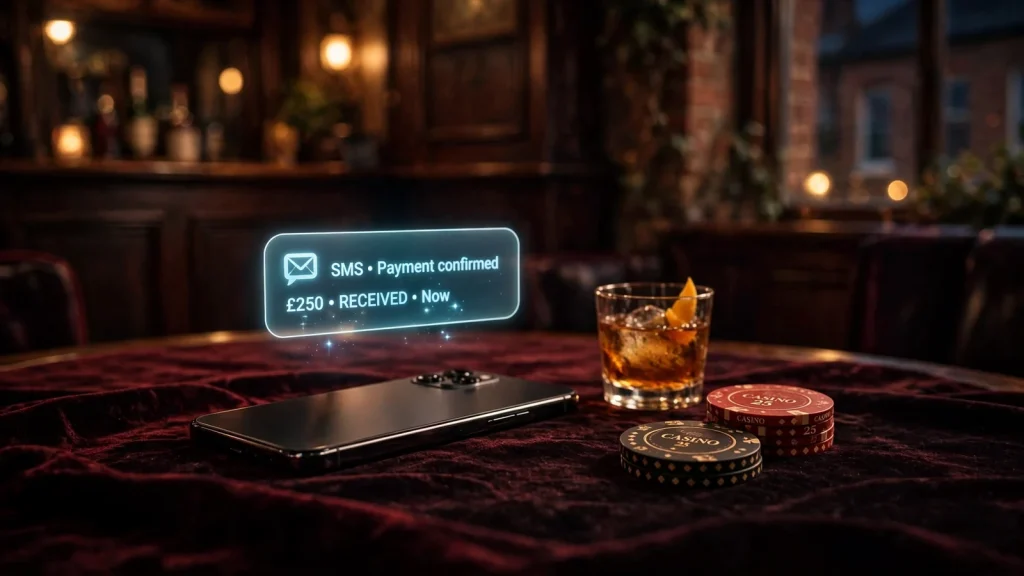
Boku deposits begin in the casino cashier, with an SMS code confirming the mobile payment rather than initiating it.
Table of Contents
- What “pay by SMS” means at the cashier
- Why the list of casinos accepting Boku keeps shrinking
- Boku deposit limits: transaction amounts, daily caps and PAYG balance
- Before depositing: UK licensing and account safeguards
- How a Boku deposit reaches the mobile bill
- Mobile network support and the move beyond Boku
- Where direct Boku acceptance still exists
- When a casino uses another mobile-payment provider
- Withdrawals, bonus terms and the limits of phone payments
- Using SMS deposits for online slots
- Sweety Win Payments and Deposit Methods in the UK
What “pay by SMS” means at the cashier
“Pay by SMS” sounds as though a deposit is made by sending a text message to the casino. With Boku, the process starts in the casino’s cashier instead. The text message is part of the confirmation step: the player selects Boku, enters a deposit amount and mobile number, then uses an SMS verification code to confirm the transaction.
That distinction matters. The cashier is where the payment is set up; the phone is where the confirmation arrives. Boku connects those steps, so a casino offering this option may describe it as Pay by Phone, pay by SMS or a mobile deposit. The wording can vary, but the essential flow is the same.
I read a payment screen as a sequence of checks, not as a promise that a particular button will appear on every account. First, the cashier presents the methods available for that casino account. If Boku is listed, selecting it opens the relevant deposit fields. The player enters the intended amount and the mobile number to be used for confirmation. The number needs to be entered accurately: the verification message is sent there, and the next step depends on receiving and using its code.
The SMS code links the confirmation to the payment being set up. It is not a casino password or a withdrawal instruction. The player enters the code in the payment flow to confirm the Boku deposit. Until that confirmation is completed, the transaction has not gone through the full stated process. The practical point is simple: selecting Boku alone is not the same as authorising a deposit.
This is why “SMS deposit” can be a slightly misleading shorthand. The text is not necessarily the place where the deposit is initiated. The player does not begin by composing a message to the casino; the cashier collects the payment details and prompts the SMS verification. The mobile phone is part of the authorisation route, while the casino cashier remains the place where the deposit is requested.
Casinos That Accept InstaDebit in the UK: What to Check · Casinos That Accept Neosurf in the UK: Payment Checks
For a UK pay-by-SMS casino, availability is therefore visible at the point of payment. A site may have a general page discussing mobile payments, but the relevant check is whether Boku appears among the methods offered in the account’s cashier. Payment menus can differ between operators, so the label alone does not establish that every casino accepts Boku. Nor does the presence of another mobile-payment method mean that it is Boku: the provider named in the cashier is the useful detail.
The amount and phone number are separate entries in the process. The amount states what the player is asking to deposit; the number is where the confirmation message is sent. The SMS code then confirms the transaction. Keeping these stages distinct helps explain what has happened if the payment is not completed: choosing a method is one action, entering the requested details is another, and confirming the code is the final step described in the Boku flow.
There is no card number to enter as part of this sequence. That is part of the appeal of a casino with pay by SMS: the deposit is arranged through the mobile-payment route rather than by typing card details into the cashier. But it should not be mistaken for a complete account-payment solution. Boku handles deposits only. It cannot be selected later as the destination for casino winnings.
That deposit-only distinction is easy to overlook because many cashier menus group deposits and withdrawals under one account heading. They are different functions. Boku can be used to put funds into a casino account, but it cannot return a balance or winnings to the phone through the same method. A player using Boku still needs another route for withdrawing funds; the deposit confirmation does not create one.
In practical terms, the cashier controls the request, the mobile number receives the verification message, and the code confirms the Boku deposit. No mystery. Just a short payment sequence—with a clear boundary at withdrawal.
Why the list of casinos accepting Boku keeps shrinking
If you’re looking for an online casino that accepts SMS deposits, this list offers a starting point for checking your options. Consider the payout speed noted for each operator when deciding what to explore.
1. Revery Play
Payout speed: 1-3 business days Revery Play lists a payout speed of 1–3 business days. This is the only specific detail available here to help you assess it.
2. Dieselwin
Payout speed: 1-3 business days Dieselwin lists a payout speed of 1–3 business days. This is the only specific detail available here to help you assess it.
3. Britsino
Payout speed: 1-3 business days Britsino lists a payout speed of 1–3 business days. This is the only specific detail available here to help you assess it.
4. SpinFormula
Payout speed: 1-3 business days SpinFormula lists a payout speed of 1–3 business days. This is the only specific detail available here to help you assess it.
5. Amunbet
Payout speed: 1-3 business days Amunbet lists a payout speed of 1–3 business days. This is the only specific detail available here to help you assess it.
6. BeOnBet
Payout speed: 1-3 business days BeOnBet lists a payout speed of 1–3 business days. This is the only specific detail available here to help you assess it.
7. Zombillion
Payout speed: 1-3 business days Zombillion lists a payout speed of 1–3 business days. This is the only specific detail available here to help you assess it.
8. SlotoSport
Payout speed: 1-3 business days SlotoSport lists a payout speed of 1–3 business days. This is the only specific detail available here to help you assess it.
9. Jetsetspins
Payout speed: 1-3 business days Jetsetspins lists a payout speed of 1–3 business days. This is the only specific detail available here to help you assess it.
10. NightWin
Payout speed: 1-3 business days NightWin lists a payout speed of 1–3 business days. This is the only specific detail available here to help you assess it.
The number of UK-licensed casinos taking Boku deposits has been falling since 2023. A small group still accepts them, but availability is no longer something that can be assumed from the presence of Pay by Phone elsewhere in the market. For operators, keeping a payment option in the cashier is a decision about whether its risks remain acceptable, not simply whether the technology can process a transaction.
The distinction matters because a shrinking list can easily be mistaken for a regulator’s blanket prohibition. The UK Gambling Commission did not introduce a rule naming Boku and banning casinos from offering it. Individual operators have withdrawn the method because of compliance risk. That is a different kind of change: it is a series of commercial and compliance decisions, rather than one instruction that automatically removed Boku from every casino.
From the operator side, a payment method is not judged only by whether a deposit reaches an account. The operator also has to be comfortable with the compliance arrangements around offering it. If the business considers the risk too difficult to manage, or the arrangements no longer fit its requirements, it can remove the method from its own cashier. The decision can be made without Boku being unlawful in itself and without a UKGC announcement ordering every licensee to stop using it.
Individual operators may withdraw Boku from their cashier due to compliance risks, even if the UK Gambling Commission has not issued a blanket prohibition on the method.
That is the uncomfortable part. “Accepted” sounds like a stable feature, as though a cashier option will remain available once it has appeared. In practice, payment availability is conditional. A casino may review its methods and decide that one no longer belongs in its offering. Another operator may reach a different conclusion. The result is uneven availability: the method remains at some UK-licensed casinos while disappearing from others.
A regulator’s role and an operator’s role should not be blurred. The Commission sets and enforces requirements for licensed gambling businesses. An operator must then decide how to run its business within those requirements, including which payment arrangements it is prepared to maintain. A method can therefore be removed as a precaution or as part of an operator’s own compliance assessment, even where there has been no specific Commission ban on that method.
In payment language, that difference often gets flattened into a simple claim that Boku has been “banned”. It has not. The more accurate account is less dramatic: some casinos have stopped accepting Boku because they regard the associated compliance risk as unacceptable. The distinction is not just semantic. It explains why availability can contract without a single industry-wide deadline, and why a blanket claim about every casino would be unreliable.
It also explains why one casino’s decision cannot establish what another will do. Each operator controls its own cashier and makes its own assessment. A business that keeps Boku is not proof that the risk has disappeared across the market; a business that removes it is not evidence that the regulator has outlawed it. Both decisions can coexist under the same regulatory framework.
For the player, the practical effect is a narrower field of choice. A remembered cashier option, an old review, or a general description of a casino’s payment methods may not reflect the operator’s current position. The trend since 2023 is clear at market level, but it does not turn the remaining availability into a permanent promise. Payment pages change, and an operator can revise its offer.
Availability Trends
- Boku is available at some licensed casinos, but the number of operators offering it has fallen since 2023.
- The UK Gambling Commission did not ban Boku; removals are commercial and compliance decisions by operators.
- Availability is conditional and can change independently from one casino to another.
There is a useful discipline in separating three statements: Boku can be used at some licensed casinos; fewer casinos have continued to offer it since 2023; and the Commission did not issue a Boku-specific ban. Those statements fit together. None requires the claim that all casinos have withdrawn the method, or that every operator is obliged to do so.
From inside the counter, this is how a payment list narrows: not necessarily through a public announcement, but through individual decisions about what a business is willing to support. Compliance risk can be enough to make an operator remove an option, even if the method remains available elsewhere. No single switch. Just fewer cashiers keeping it.
Boku deposit limits: transaction amounts, daily caps and PAYG balance
A Boku deposit has more than one possible ceiling. The amount shown by a casino, any limit applied by the mobile network and the available balance on a pay-as-you-go account can all affect whether a payment is accepted. These controls are separate, so a figure advertised as a casino limit does not necessarily describe what the network will allow.
The published figures do not line up neatly. One account of UK Boku limits gives a transaction ceiling of £30, while allowing that some casinos or network operators may set it at £40 or £50. Specialist payment reviews describe a different pattern: deposits of about £10 per transaction, with a £30 daily network limit. Other descriptions specify a daily total of £30 but give no separate per-transaction ceiling. Those versions should not be combined into a single standard. They reflect reported arrangements, not a dependable rule for every casino and mobile account.
Casinos That Accept POLi in the UK: Payment Checks · Casinos that accept Revolut in the UK: payment rules
That distinction matters in practice. A casino cashier may display an amount that appears to fit within its own limit, yet the network can still decline it if a separate restriction applies. Equally, a casino may set a lower maximum than the amount a network could technically process. The usable ceiling is the lower of the applicable restrictions. A payment method can therefore be available in the cashier without every displayed amount being available to every customer.
There is also a reported denomination constraint. Specialist reviews say Boku deposits may be limited to amounts divisible by ten, such as £10, £20 or £30. Under that arrangement, a customer cannot simply choose an arbitrary amount between the listed options. This is a separate issue from the maximum: the maximum describes how large a deposit may be, while the denomination rule governs which amounts can be selected within that ceiling. As with the other reported limits, availability can differ between operators and networks.
The apparent disagreement over a per-transaction cap is worth keeping visible. Some specialist reviews identify a specific transaction figure; others describe a daily cap without specifying a transaction maximum. It would be misleading to treat the £10 figure as universal, or to infer that a £30 daily limit means a customer can make any number or size of deposits until that total is reached. The available descriptions do not establish one common schedule across UK Boku casinos. The cashier’s current options and the mobile operator’s decision at the point of payment determine what works.
Reported Boku Limit Variations
Different sources report different ceilings: some mention a transaction ceiling of £30 (with some at £40 or £50), while others cite £10 per transaction with a £30 daily network limit.
Daily limits are also attributed to different parts of the system in different descriptions. Specialist payment reviews say that the mobile operator enforces the daily Boku ceiling rather than the casino. If that is how a particular payment is configured, the casino cannot override a network refusal simply by accepting the deposit amount in its own cashier. The network may already have counted earlier Boku payments against its limit. The precise calculation and reset arrangements are not consistent enough to state as a universal timetable, so no general reset hour or additional allowance should be assumed.
PAYG accounts add a straightforward balance constraint. Specialist reviews report that a prepaid customer cannot make a Boku deposit greater than the remaining mobile credit. A deposit that fits the casino’s stated maximum may still fail if the available PAYG balance is lower. This is not another casino limit; it is the amount of prepaid credit available to fund the charge. With a monthly phone plan, the relevant constraint may instead be the network’s or casino’s applicable limit.
I have found it more useful to think of the amount accepted as a series of gates, rather than one headline maximum: the casino’s permitted amount, any network transaction or daily restriction, and—on PAYG—the remaining balance. Passing one gate does not guarantee passage through the others. A failed attempt does not, by itself, show that Boku is unavailable altogether; the selected amount may simply exceed one of the limits applying to that account.
Jeton Casino Sites in the UK: Payment Availability · Casinos That Accept USDC in the UK: Payment Checks
For anyone comparing an SMS deposit casino with another payment option, the practical point is modest but important: the maximum shown in a review is not a promise that the same amount will be accepted on every account. Limits can vary, and the published accounts conflict over whether there is a fixed per-transaction ceiling in addition to the daily cap. Treat specific figures as reported conditions, not as a single UK-wide tariff. A smaller permitted amount, a daily restriction already reached or insufficient PAYG credit can each be enough to stop the payment.
Before depositing: UK licensing and account safeguards
A Pay by Phone option in a cashier says how a deposit can be made; it does not establish that the casino is authorised to offer gambling in Great Britain. I keep those checks separate. Payment branding can look familiar while the operator behind it still needs the right permission.
The UK Gambling Commission oversees commercial gambling in Great Britain, including remote casino services. Its reach does not depend on where a company keeps the equipment that runs its website: an operator offering remote gambling to people in Great Britain must hold the relevant Commission licence. In this market, commercial gambling has one regulator, rather than a separate licensing authority for each payment method.
That distinction matters when a casino accepts Boku. The method’s appearance is not evidence of a licence, and a UK-facing design is not evidence either. Before depositing, the operator’s current licence should be checked on the Commission’s public register. A valid operating licence is the threshold for a legal online casino serving players in Great Britain, not a badge that can be inferred from the cashier.
Licensing Check
The presence of a Boku payment option is not evidence of a licence. You must check the operator’s current licence on the Gambling Commission’s public register before depositing.
The Commission issues operating permissions to gambling businesses and personal licences to individuals in roles that require them. The first concerns the business offering the casino; the second applies to people working in regulated positions. They are related parts of oversight, but they are not interchangeable. A payment provider does not replace the operator’s responsibility to be licensed.
I have seen how easily a payment label can become a shortcut in people’s thinking. “Trusted” may describe a recognisable name or a familiar checkout flow; it does not tell anyone whether the gambling business is authorised. Separate the two questions. Is the operator licensed? Is the payment option available? The first is a regulatory matter; the second is a cashier feature.
Licensing also sits alongside account protections. Operators must verify a customer’s age before allowing deposits, and remote operators must prompt new customers to set a financial limit before their first deposit. Account-level limit controls must remain accessible. Licensed casinos must provide responsible-gambling tools, including self-exclusion, and an internal complaints process with access to an approved Alternative Dispute Resolution service.
Those protections do not make every deposit suitable for every account. They define obligations on the operator and give the customer routes to manage gambling or raise a dispute. The practical point is that a logo, a payment method or a polished site cannot substitute for checking the licence and understanding the safeguards attached to the account.
For anyone comparing casino sites that take SMS deposits, the regulatory check belongs before the payment choice. A short list of available methods can change; authorisation is a separate question and should be confirmed directly against the Commission’s register. Keep the distinction clear. Payment is not permission.
Casinos That Accept Dogecoin in the UK: What to Check · Casinos That Accept E-Wallets in the UK
How a Boku deposit reaches the mobile bill
A Boku deposit is funded through the mobile account rather than directly from a bank account or card. The amount is either added to the customer’s monthly phone bill or taken from prepaid credit on a pay-as-you-go (PAYG) service. Those are different billing routes, but both use the mobile account as the source of funds.
On a monthly plan, the deposit becomes a charge associated with the phone account. It is therefore accounted for alongside the customer’s mobile service, rather than being paid from a separate card balance at the point of deposit. The practical distinction is where the cost sits: the casino receives a deposit, while the corresponding payment is handled through the mobile billing relationship.
PAYG works differently because there is no later monthly bill to settle. The deposit is deducted from the credit already available on the prepaid service. That credit is the funding pool for the transaction; the casino deposit does not create a separate amount owed on a future phone bill. If the available credit cannot cover the intended payment, the prepaid route cannot fund it.
This is the part that can be obscured by the phrase “SMS billing”. It describes a way to charge a mobile account, not a separate casino balance or a cash withdrawal from the handset. The underlying source is either the monthly account or prepaid credit. Same phone, different accounting.
Do
- Check if you are on a monthly plan for billed charges
- Check your remaining credit on a PAYG account
Don’t
- Assume a phone number determines the billing route
- Mistake SMS billing for a separate casino balance
In my experience, it helps to treat the mobile account as the payment instrument and the casino cashier as the place where the deposit is requested. The casino records the funds in the gambling account; the mobile provider’s billing route determines whether the cost joins the monthly phone charges or reduces PAYG credit. A phone number alone does not tell which route applies: that depends on the customer’s mobile plan.
This distinction matters when reviewing personal spending. With a monthly plan, the deposit is part of the phone-account charges; with PAYG, it reduces the credit available on the service. Neither route changes the nature of the casino transaction. It is still a deposit funded through the mobile account, not a conventional card payment. The bill is the record of the funding route, not a second casino transaction.
Mobile network support and the move beyond Boku
Network compatibility is only one part of a Pay by Phone deposit. EE, O2, Vodafone and Three support pay-by-mobile payments and Fonix, but that does not mean every casino using one of those services will accept every customer on those networks. The operator must also offer the relevant payment method in its cashier. A supported network is a route, not a guarantee that a particular deposit option will appear.
That distinction matters when a mobile casino deposit by SMS is being considered. “Available on your network” sounds like a complete answer; in practice, it describes the network’s ability to carry the payment, not the casino’s decision to accept it. A method can be supported by a carrier while absent from a casino’s payment menu. The cashier is the final check.
Skrill Casino Sites in the UK: What to Check
The naming can also be misleading. Pay by Phone describes the broad payment category, while Boku and Fonix are separate services within that space. A casino that offers Pay by Phone has not necessarily retained Boku. The label alone does not identify the provider handling the transaction.
A specialist review of the market’s payment options describes operators moving away from Boku since 2023. Some have adopted other mobile-payment services; others have removed phone payments altogether. This is not a uniform change across the industry, and a method shown in an older guide may no longer be available at the same operator. Payment menus change. The brand name is not a standing promise.
For someone comparing mobile casinos that accept SMS deposits, the practical distinction is between three situations: Boku remains available, a different provider handles phone billing, or there is no mobile-payment option. These are not interchangeable. A casino may still accept a phone-funded deposit while no longer processing it through Boku; another may offer no phone route at all. “SMS deposit” can therefore describe the general experience without specifying the underlying service.
Network support narrows the question, but does not settle it. EE, O2, Vodafone and Three are named as supporting both pay-by-mobile payments and Fonix. Whether that support applies to a particular account and casino depends on the payment option actually presented there. Carrier compatibility is the first condition, not the whole transaction.
Network support from EE, O2, Vodafone, and Three is a necessary condition for pay-by-mobile payments, but it does not guarantee that a specific casino will offer the method in its cashier.
Where direct Boku acceptance still exists
Direct Boku acceptance is now associated with a small, identifiable group of casino sites rather than a broad choice across the UK market. A specialist review identified Jackpot Mobile Casino and Peachy Games as examples. These are reported as taking Boku itself, not merely offering a different Pay by Phone service.
That distinction matters. A casino can support payments billed through a mobile network without accepting Boku. A general label such as “SMS deposits” therefore does not establish which provider handles the payment. For a direct-Boku option, the method needs to be named as Boku in the casino’s own payment information or cashier.
The two names are examples, not a ranking. There is no meaningful order to infer from their appearance here, and being identified in a review does not establish that the method remains available to every customer or at every point in time. Payment menus can change; the cashier is the practical test of what the account can use when a deposit is being made.
I have seen the distinction get blurred in casino payment copy: a page may describe phone billing broadly, while the cashier presents a different provider. That is not the same as direct Boku acceptance. The wording on the payment page may help narrow down what is offered, but the method shown for the account is the useful detail.
For anyone comparing sites specifically on this basis, the short answer is that Jackpot Mobile Casino and Peachy Games have been identified as direct-Boku examples. The set is limited, and the names should be treated as leads to verify rather than a standing promise of availability. No ranking implied.
UK Casino Sites That Accept EcoPayz: Payz Explained
When a casino uses another mobile-payment provider
A casino can offer Pay by Phone without using Boku. Fonix and Siru Mobile are separate providers, so a site that accepts one of them should not be described as a direct-Boku casino. The distinction matters at the cashier: the provider shown there determines how the payment is routed, even if the broad experience looks similar to an SMS deposit.
A specialist payment-method review identifies MrQ and Duelz as casinos using Fonix, and Mr Vegas and Videoslots as using Siru Mobile. Those examples are provider-specific, not a general list of every operator with mobile payments. Payment menus can change, so the method needs to be checked in the account cashier rather than inferred from an old mention of SMS or phone billing.
From my time looking at cashier setups, the label is more than branding. Operators can retain Pay by Phone while changing the company that handles the transaction. That is why a search for a Boku casino and a search for a casino taking SMS payments can lead to different answers: one asks for a particular provider, the other describes a payment route that may be supplied by another company.
O2 customers may see mobile-payment options at participating casinos, but O2 support alone does not establish that a particular operator uses Boku, Fonix or Siru Mobile. Network compatibility and casino-provider availability are separate checks. An SMS confirmation can be part of the process without identifying Boku as the provider.
The practical point is simple: read the cashier’s method name. MrQ and Duelz are the confirmed Fonix examples; Mr Vegas and Videoslots are the confirmed Siru Mobile examples. None should be counted as a direct-Boku option on that basis alone. Provider names matter.
Fonix
Used by casinos such as MrQ and Duelz.
Siru Mobile
Used by casinos such as Mr Vegas and Videoslots.
Boku
Directly accepted by a small group, including Jackpot Mobile Casino and Peachy Games.
Withdrawals, bonus terms and the limits of phone payments
A Boku payment can put money into a casino account, but it cannot take winnings back out. It is a deposit route, not a complete way to move money in both directions. In practice, that means a separate withdrawal method has to be registered when depositing with Boku. The casino’s cashier sets out which options are available for withdrawals; the mobile bill does not become a route for cashing out.
That distinction is easy to miss in a cashier labelled “SMS payment”. The label describes how the deposit is authorised and charged, not what happens to a later withdrawal. I have seen payment methods treated as interchangeable because they appear together on one screen. They are not. Deposit and withdrawal rules can differ.
Bonuses add another condition. Pay by Phone deposits may be excluded from welcome offers, and eligibility varies by operator. A specialist review identified MrQ, Duelz, Mr Vegas and Videoslots as accepting such deposits for bonus eligibility, but that is not a blanket rule for other casinos or a substitute for the terms attached to a specific offer. The bonus wording decides whether a phone-funded deposit qualifies. A familiar welcome offer is no guarantee.
There is also a reported workaround for accounts that need a different casino deposit route: a specialist review described funding Neteller with Boku, then using Neteller at casinos that accept it. That is a separate chain of payments, not a Boku withdrawal. Whether it works depends on the services and account rules involved, so it should not be read as a universal route or as a way to bypass a casino’s payment checks.
The practical picture is narrower than “SMS casino payments” can suggest: Boku may cover the deposit, while withdrawals and bonus eligibility remain governed by separate rules. Phone payment at the cashier. Nothing more.
Casino sites that accept credit cards in the UK: rules
Using SMS deposits for online slots
Pay by Phone can fund an account used for online slots, but it does not create a separate class of game or guarantee that every slot at a casino can be played with a particular payment method. The cashier handles the deposit; the casino’s games and account terms govern what happens after the funds arrive. “SMS slots” is shorthand, not a distinct product.
The practical distinction appears when a slot offer is involved. A deposit may reach the balance successfully while still failing to qualify for a welcome promotion. Eligibility depends on the operator’s terms, not on the fact that the money came from a mobile payment. A specialist review reported no Boku-specific deposit restrictions at the platforms it assessed, but that finding should not be treated as a market-wide rule. Terms can differ between casinos and offers.
I have seen the payment method and the promotion treated as separate decisions: the cashier accepts the deposit, while the bonus rules decide whether it counts towards an offer. That separation is easy to miss when an advert presents a bonus as if it applies to every deposit. Read the payment exclusions attached to the specific promotion before relying on it. No assumption is safe.
Pay-by-phone deposits are commonly excluded from welcome offers, so the headline bonus should not be taken as evidence that an SMS-funded slot session qualifies. Where eligibility is unclear, the written terms or the operator’s support team are the useful reference points. A successful payment alone does not settle the question.
Slot play also remains subject to the casino’s account controls and the rules applying to UK-licensed operators. Autoplay is not allowed in Britain, and each online slot spin must last at least two and a half seconds. Those restrictions concern how slots are played, not how the deposit is made. Mobile billing changes the funding route; it does not change the game rules.
What are the deposit limits at pay by mobile casinos?
Boku deposits are typically limited to about £10 per transaction and £30 per day by the mobile network. The standard UK limit is £30 per transaction, although some casinos or networks may allow £40 or £50; deposits are in amounts divisible by ten, and PAYG users are also limited by their remaining phone credit.
How to deposit with Boku at online casinos?
Choose Boku in the casino cashier, enter an eligible amount and your mobile number, then enter the SMS verification code to confirm the deposit. The charge is added to your mobile bill or deducted from your PAYG credit.
How does Boku work?
You set up the deposit in the casino cashier and confirm it using a code sent to your mobile phone. The amount is charged to your phone bill or taken from your PAYG credit, and Boku cannot be used to withdraw casino funds.
How can I be sure Boku is available where I live?
Check whether Boku appears in your casino account’s cashier, since availability varies between operators. Pay by mobile is supported by EE, O2, Vodafone and Three.
Sweety Win Payments and Deposit Methods in the UK
Sweety Win Withdrawals, Limits and Payout Checks
Sweety Win UK Guide Cash-out checks before you deposit A Sweety Win withdrawal should be...

Anonymous Crypto Casinos in the UK: What to Know
Crypto payments may make registration less involved, but licensing, identity checks and withdrawal terms remain...

Instant Withdrawal Casinos UK: How Payouts Work
A practical look at request handling, payment methods, bonus conditions and checks that can affect...

Binance Coin BNB Casino Comparison in the UK
The guide separates Great Britain’s crypto rules from unverified claims about BNB acceptance, games and...

Bitcoin Cash Casino Comparison UK: Licensing and Fees
Bitcoin Cash acceptance does not establish a casino’s UK licence, so compare regulatory status separately...

Cardano ADA Casino Comparison for the UK Market
The comparison distinguishes technical access to offshore sites from permission to offer remote gambling in...
Casino Not on GamStop: Instant Withdrawals Explained
Withdrawal speed depends on more than a casino’s claim, including the cashier route, verification and...
Casino sites that accept credit cards in the UK: rules
UK-licensed casinos cannot take credit-card gambling payments; available alternatives, costs and withdrawal rules shape how...

Casino Sites That Accept Debit Cards in the UK
Card availability depends on the cashier and payment processing, while deposit and withdrawal options may...

UK Casino Sites That Accept EcoPayz: Payz Explained
EcoPayz was rebranded as Payz, but casino cashier options can differ for deposits and withdrawals....

Jeton Casino Sites in the UK: Payment Availability
Jeton is available at only a handful of UK casinos, so confirm it in the...

Skrill Casino Sites in the UK: What to Check
A Skrill listing signals possible payment access, not a quality mark; availability, conditions, payouts and...
Casinos That Accept Apple Pay in the UK: Payment Terms
Apple Pay and pay-by-phone are separate methods, and deposit acceptance alone does not establish bonus...

Casinos That Accept AstroPay in the UK: What to Check
Availability depends on the casino, account and transaction, so the cashier is more reliable than...

Casinos That Accept Bank Cheques in the UK
A bank cheque and a Boku deposit use different funding routes, with phone-account eligibility, limits...

Casinos That Accept Bank Transfer in the UK
Compare Boku, Fonix and Siru Mobile, and check funding, limits and bonus terms before choosing...

Casinos That Accept Bitcoin in the UK: What to Check
A casino’s cryptocurrency label may not confirm which asset, network or transaction type its cashier...

Casinos That Accept Boku in the UK: Deposits and Limits
Boku funds a casino account through a phone bill or available prepaid credit, while game...

Casinos that accept CashToCode in the UK: what to check
CashToCode availability can depend on the account and operator setup, so a brand mention alone...

Casinos That Accept Citadel in the UK: Payment Guide
Citadel availability must be checked in the cashier, while slot access, bonus terms and payout...
Casinos That Accept Click2Pay in the UK
Click2Pay availability can vary by casino account, while deposits, withdrawals, fees and currency conversion follow...
Casinos That Accept ClickandBuy in the UK
Payment availability can vary by account, while bonus eligibility, withdrawals and transaction costs are separate...
UK Casinos That Accept Debit Cards: Payment Guide
Debit cards are one cashier option, with deposits, withdrawals, eligibility and fees shaped by the...

Casinos That Accept Diners Club in the UK
A Diners Club option in the cashier does not by itself establish bonus eligibility or...

Casinos That Accept Dogecoin in the UK: What to Check
A Dogecoin mention does not confirm that deposits are available or eligible for a casino...
Casinos That Accept E-Wallets in the UK
The cashier shows which wallet services are available for an account and whether they support...
Casinos That Accept E-checks in the UK: How to Check
An e-check name in casino material is not proof that the method can fund a...

eCheques at UK casinos: what searches can confirm
A payment label alone cannot confirm availability, and a casino may handle deposits and withdrawals...

Casinos That Accept Entropay in the UK: Payment Checks
UK cashier options can depend on account location, currency and provider rules, while deposit and...

Casinos That Accept Ethereum in the UK: Payment Checks
Ethereum support depends on what the cashier offers for the account, while network details, transaction...
Casinos That Accept Giropay in the UK
A payment option does not confirm bonus eligibility, slot contribution or that withdrawals will use...
Casinos That Accept Google Pay in the UK: What to Check
Google Pay availability can depend on the account, and deposit support does not establish that...
Casinos That Accept iDEAL in the UK: What to Check
Payment availability, bonus eligibility and withdrawal rules are separate checks, even when an iDEAL option...

Casinos That Accept InstaDebit in the UK: What to Check
InstaDebit availability, bonus eligibility and withdrawal handling are separate checks, and the article explains what...

Casinos That Accept Interac in the UK: What to Check
A cashier listing can indicate a payment route, but game availability and promotion eligibility require...
Klarna at UK Casinos: What Can Be Confirmed
Klarna branding alone does not confirm an eligible route; UK casinos must not accept credit-card...

Casinos That Accept Litecoin in the UK: Payment Checks
A practical guide to bonus eligibility, cashier checks, withdrawal verification and the limits of claims...
Casinos That Accept Maestro in the UK: What to Check
A cashier listing confirms a deposit route, but bonus terms and withdrawal options may follow...
Casinos That Accept Mastercard in the UK
A Mastercard funds the casino account, while slots use the balance held there rather than...
Casinos That Accept MiFinity in the UK: Payment Guide
MiFinity acceptance, slot-bonus terms and withdrawal checks are separate issues, so confirm each in the...
Casinos and Monzo in the UK: What Payment Evidence Shows
Monzo and Boku are distinct payment options, so support for one does not establish that...

Casinos That Accept MuchBetter in the UK: How to Check
Availability varies by operator and account, so the live cashier is the clearest check before...
Casinos That Accept Neosurf in the UK: Payment Checks
A guide to cashier availability, payment compatibility, deposit timing and why withdrawal options may differ....

Casinos That Accept Neteller in the UK: Payment Guide
Neteller availability is only one part of the decision: bonus rules, withdrawal checks and cashier...

UK Casinos That Accept Pay N Play and Boku
Pay by Phone is a broad label, while Boku is a specific deposit route with...

Casinos That Accept PayPal in the UK: What to Check
PayPal availability, casino deposits, slot play and promotional terms are separate checks, each governed by...

Casinos That Accept POLi in the UK: Payment Checks
A cashier listing shows presented deposit routes, while bonus terms and withdrawal options must be...

Casinos that accept Revolut in the UK: payment rules
Payment acceptance, bonus eligibility and withdrawal rules are separate checks when using Revolut at an...

Casinos That Accept XRP in the UK: Payment Checks
XRP availability, game eligibility, bonus terms and withdrawals are separate questions, and each needs checking...
Casinos That Accept Siru Mobile in the UK
Siru Mobile is a funding option, not a guarantee of specific games, bonus eligibility or...
Casinos That Accept Solana in the UK: What Is Verified
Account access, cashier instructions and game listings are separate evidence, so a Solana label alone...

Casinos That Accept Tether in the UK: Payment Checks
Payment pages can list cryptocurrency without naming Tether, so availability and transaction details need separate...

UK casinos that accept Ukash: payment options
Compare card, e-wallet and bank-based options, plus the deposit, withdrawal and promotion conditions that can...
Casinos That Accept Upaycard in the UK: How to Check
Cashier availability and promotion terms are separate checks, and a deposit option does not guarantee...

Casinos That Accept USDC in the UK: Payment Checks
A slot catalogue, account cashier and promotion terms each confirm different parts of the payment...
Casinos That Accept Visa in the UK: Deposits and Terms
Visa funds an account, but the casino's rules determine bonus eligibility, available games and how...
Casinos that accept WebMoney in the UK
WebMoney and Boku are distinct, and evidence about deposits, bonuses, withdrawals or GamStop status does...
Casinos That Accept Wire Transfers in the UK
Bank transfers can mean different payment rails, with separate rules for casino deposits, withdrawals, timing...

Wirecard Casinos in the UK: Payment Checks Explained
A Wirecard listing does not confirm casino support, game access or whether a deposit qualifies...

Casinos That Accept Zimpler in the UK: Payment Checks
Zimpler availability can vary by casino account, and a deposit option alone does not establish...

Fast Withdrawal Casinos in the UK: How Payouts Work
A withdrawal’s total wait runs from confirmed request to funds arriving, with the payment route...

Instant Bank Transfer Casinos in the UK: A Guide
Bank transfer availability varies by operator and account, so payment labels and general information do...

iPad Casinos in the UK: Browser Access Explained
Browser access, apps, games and cashier options are considered separately, with a focus on what...
Mobile Top-Up Casinos in the UK: Payment Guide
Mobile billing is distinct from paying by card on a phone, and deposit and withdrawal...

Pay-by-Mobile Casinos UK: How Deposits Work
Pay by mobile is a deposit route through a phone account, separate from using a...
Pay by phone bill at UK casinos: how it works
See how phone-bill deposits work, where to find the option in a casino cashier, and...

Pay by Phone Casinos UK: Deposits Explained
Payforit routes a casino deposit through the mobile number entered, with the cost billed to...
Payforit Mobile Casinos in the UK: How It Works
Payforit is a mobile payment option, not a type of casino, and its availability can...

Quick Withdrawal Casinos in the UK: What to Expect
Withdrawal speed depends on more than the transfer itself: payment route, casino processing and bonus...
Same-day payout casinos in the UK: how timing works
Payout speed depends on both casino confirmation and the payment route, so a quick decision...

Online Casino Payouts in the UK: How RTP Works
RTP describes a game's theoretical return over extensive play, while individual results and the speed...

Casinos That Accept Direct Banking: How Payments Work
Open Banking can initiate a bank payment, but cashier labels, ownership checks and withdrawal rules...

TRON and TRX Casino Comparison for UK Players
TRON payment support does not establish UK licensing; the key distinction is whether an operator...

UK Crypto Casinos With No KYC: The Limits
A practical look at offshore status, UKGC licensing and what Bitcoin Cash does—and does not—change...