
Online Casino Game Shows in the UK: How to Compare
 Available in GB
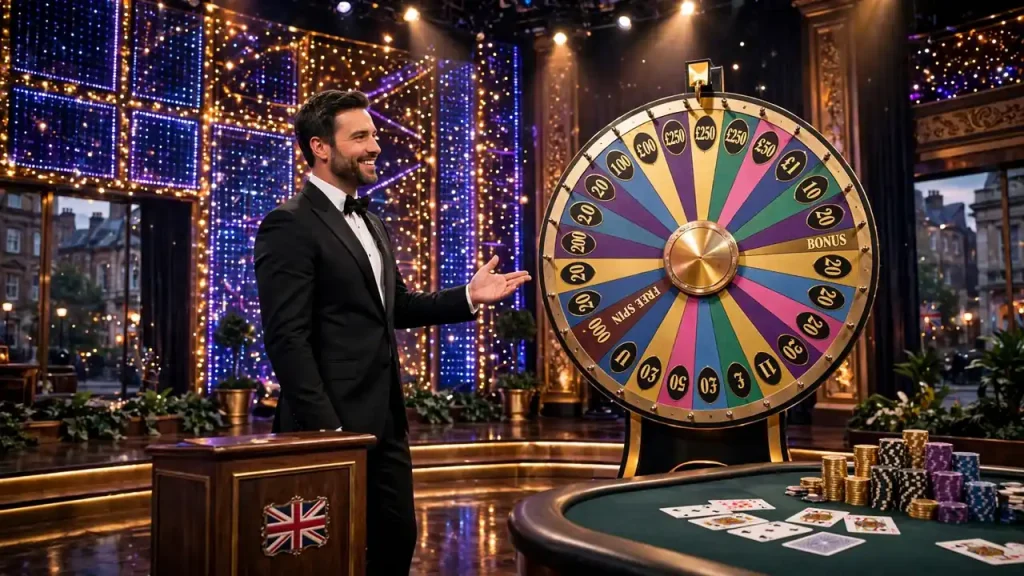
The label can signal an entertainment-led format, but title-level details are needed to establish how each game works.
Table of Contents
- How Live Game Shows Differ from Standard Casino Games
- Casino Game Shows as a Live Format
- What Online Live Casino Game Shows Cover
- Assessing Game Shows Without an Unverified ‘Best’ List
- The UK Regulatory Frame for Casinos with Live Game Shows
- Crazy Time and Funky Time: What Can Be Confirmed
- Finding Live Game Shows at UK Casinos
- Comparing Live Casino Game Shows
- A Live Game-Show Casino Is Still an Online Operator
- Casino Game Shows Online: Availability Needs Checking
- Slots
How Live Game Shows Differ from Standard Casino Games
The distinction is clearest in the way the two labels frame an experience. “Standard casino games” points to familiar gambling categories, such as slots or table games. “Live game shows” presents the experience as entertainment organised around a show-like format. That difference in framing can shape what a player expects, but the label alone does not establish how a particular game works.
In an online casino, the category name is not a rulebook. It does not, by itself, confirm that a presenter appears on screen, that a particular stage or set is used, or that a round follows any specific sequence. Those details belong to the individual game, not to the broad phrase. I treat the category label as a signpost, not a specification.
That matters because “live” can sound more precise than it is. In ordinary use, it may suggest a real-time broadcast or interaction. But the words in a lobby cannot prove what is happening behind the interface, how outcomes are produced, or whether participants can affect them. Those are separate questions requiring title-level information. A name can set an expectation; it cannot substantiate it.
When choosing an online casino for game shows in the UK, it helps to check practical details alongside the games on offer. These listings include the stated payout speed for each operator.
1. Revery Play
Payout speed: 1-3 business days Revery Play lists a payout speed of 1–3 business days.
2. Dieselwin
Payout speed: 1-3 business days Dieselwin lists a payout speed of 1–3 business days.
3. Britsino
Payout speed: 1-3 business days Britsino lists a payout speed of 1–3 business days.
4. SpinFormula
Payout speed: 1-3 business days SpinFormula lists a payout speed of 1–3 business days.
5. Amunbet
Payout speed: 1-3 business days Amunbet lists a payout speed of 1–3 business days.
6. BeOnBet
Payout speed: 1-3 business days BeOnBet lists a payout speed of 1–3 business days.
7. Zombillion
Payout speed: 1-3 business days Zombillion lists a payout speed of 1–3 business days.
8. SlotoSport
Payout speed: 1-3 business days SlotoSport lists a payout speed of 1–3 business days.
9. Jetsetspins
Payout speed: 1-3 business days Jetsetspins lists a payout speed of 1–3 business days.
10. NightWin
Payout speed: 1-3 business days NightWin lists a payout speed of 1–3 business days.
The same caution applies to “game show”. The phrase evokes a familiar kind of entertainment, but resemblance to a television format does not establish that a casino game shares its rules, production choices or relationship with an audience. It is a category description. The actual experience has to be understood from the game’s own published information.
Standard casino games are not a single, uniform opposite either. The phrase covers different kinds of products, with distinct interfaces and ways of presenting play. So the contrast is not simply “traditional games follow rules, while game shows do not”. Both categories contain individual titles, and the relevant details sit at that level. A broad label is useful for sorting; it is a poor substitute for reading what a particular title says it offers.
The practical difference, then, is mainly one of presentation and expectation. A conventional category label tends to foreground the kind of casino game being played. A game-show label foregrounds an entertainment framing. That can help explain why the product is grouped separately in a casino lobby, but it does not answer questions about pace, participation, outcome determination or the role of any host. Those should not be inferred from the shelf name.
This is where casino language can do more work than the evidence behind it. “Immersive” or “interactive” may sound like factual descriptions, yet without details about a named title they are only impressions. I would not use them as proof of a particular feature. The same applies to calling a product a live event: the wording should not be allowed to imply verified mechanics that have not been established.
Megaways Slots at UK Casinos: What to Check · UK Online Jackpot Slots: Rules and Features
For someone comparing the two categories, the useful starting point is to separate what the label tells from what it leaves open. It tells how the casino has chosen to present or group the product. It may indicate that the intended experience is framed as show-like entertainment rather than as a conventional slot or table-game category. It leaves open the actual rules, the source and timing of outcomes, and the extent of any real-time element. Those points need a description for the particular game.
That distinction also helps avoid treating the format as a guarantee of a different kind of gambling. A show-like presentation does not, on its own, tell anyone whether the underlying activity differs from other casino products in its essential terms. Nor does it establish that the entertainment framing changes the significance of an outcome. The screen may feel more event-led; the label does not settle the underlying details.
In a UK casino lobby, the same reading applies: a live game-show heading is a classification, not a complete account of every title beneath it. It should be read as a broad cue about how products are positioned, rather than as confirmation that all entries share one set of mechanics. The differences between individual games may matter more than the shared label.
There is no need to force a sharp boundary between “standard” and “show” products when the evidence only supports a difference in framing. The distinction is useful, but limited. It tells where the entertainment emphasis sits. It does not verify the machinery behind the screen.
Labels are not mechanics.
Labels vs Mechanics
A category label is a signpost for presentation and expectation, not a specification of a game’s actual mechanics or rules.
Casino Game Shows as a Live Format
“Casino game show” is a category label used for live casino entertainment, not a precise description of a particular game. It brings together two ideas: the casino setting and a show-like presentation delivered as a live format. The phrase can help distinguish this kind of offering from a standard casino lobby, but it does not, by itself, tell much about what happens on screen.
That distinction matters. In the industry, labels often do more work than their wording admits. “Live” signals a connection to a live presentation; “game show” suggests entertainment shaped around a show format. Neither term should be treated as a full specification. The label alone does not establish a title’s rules, pace, host arrangements, ways of taking part or other detailed features.
I have seen category names act as shorthand between suppliers, operators and customers. Shorthand is useful when it points to a broad kind of content. It becomes less reliable when it is mistaken for a promise about the individual experience. A page or lobby may use the same category wording for offerings that differ in their presentation. The name is a signpost, not a rulebook.
The phrase also does not necessarily describe a single, closed family of games. It can be used broadly for live casino entertainment presented in a show-like way, while the exact boundaries depend on how a particular service organises and labels its content. That makes the category useful for orientation, but too broad to settle questions about an individual title. A label can group; it cannot supply missing detail.
Microgaming Slots at UK Casinos: What Can Be Verified · Mega Moolah Casinos UK: How to Check Availability
There is a difference between saying that something belongs to a live game-show category and claiming that it has a particular feature. The first is a classification. The second requires information about the named offering itself. Without that distinction, general language can quietly turn into an unsupported claim: a reader sees a category name and assumes it guarantees a certain format or experience. It does not.
The same caution applies to the word “casino”. Here it places the entertainment within an online casino context. It does not mean that every service using the category label has the same selection, or that the label identifies the operator behind it. The casino platform and its content are related, but they are not interchangeable. Category wording describes a kind of content; it is not a complete description of the business or its catalogue.
“Live casino game shows online” is therefore best understood as a broad description of live, show-style casino entertainment accessed through an online casino environment. It is not a catalogue entry, and it does not guarantee that every casino using similar wording carries the same material. Nor does the phrase settle whether a given offering is available at a particular moment. Those are separate, title- and operator-specific matters.
This is where promotional language can blur the boundaries. Words such as “immersive” or “interactive” may sound like concrete descriptions, but without detail they remain impressions. I treat the category name as an introduction, then look for a separate explanation of the actual offering. If that explanation is absent, the sensible conclusion is limited: the content is being presented as live casino entertainment in a game-show style.
Category Scope
Category names like "live game show" are broad classifications used for orientation; they cannot supply missing technical details about an individual title.
The label is still useful. It gives a reader a way to distinguish this area of online casino entertainment from other broad content categories, without requiring every title to be described in the same words. But it should not be stretched beyond that purpose. A category tells where an offering is positioned. The particulars belong to the offering itself.
That is the scope of the term. Broad, not definitive.
What Online Live Casino Game Shows Cover
The phrase “online live casino game shows” points to a broad corner of casino entertainment rather than a single, tightly defined product. Each part sets a boundary: the activity is presented as casino content, it is accessed online, and it is associated with a live game-show style. Those words describe the category’s positioning. On their own, they do not establish a shared set of rules, a particular way of participating or a standard layout.
That distinction matters because labels do a lot of work in casino menus. A category name can help group content for browsing, but it is not a technical description. I have seen broad labels treated as if they were a promise that every item underneath works in the same way. That is where expectations get ahead of the information. A heading can signal a theme without explaining what happens during play.
“Online” describes the setting in which the category is encountered: a casino service delivered through a digital platform. It does not, by itself, tell us whether a particular title is accessible on every device, how it is presented, or whether it is available at a given operator. Those are separate questions about a specific product and its distribution. The category remains useful, but it should not be asked to answer questions it was not designed to answer.
Push Gaming Slots at UK Casinos: Licensing and Checks · Big Time Gaming Slots at UK Online Casinos
“Live” and “game show” also contribute to the impression the label creates. Together, they suggest entertainment with a live-show identity, but the words are not a substitute for title-level information. They do not establish who or what appears on screen, how a round proceeds, whether interaction is involved, or what determines an outcome. Those details can only be assessed from reliable information about the individual game. No shared blueprint should be assumed from the label alone.
The breadth, then, is primarily a matter of classification. Online casino game shows can be discussed as a family of casino content without claiming that every title shares a mechanic or presentation. This is a more careful use of the term than treating it as a catalogue with a known membership. A casino may use a category label for navigation or promotion; that does not make the label a complete inventory or a guarantee that the same content appears across platforms.
I tend to separate three things that advertising often runs together: the category name, the casino platform and the individual game. The category helps describe the kind of entertainment being discussed. The platform is the service through which casino content may be offered. The game is the specific product whose rules and presentation need their own description. Keeping those layers apart prevents a general phrase from carrying claims that belong to a particular title.
This also explains why broad descriptions can sound more definite than they are. Words such as “immersive” or “interactive” may be used as promotional shorthand, but without details attached to a named game, they tell little about what the experience involves. The category is not evidence of a particular feature. A label is a label.
Do
- Separate the category name from the platform and the individual game
- Use the label as a broad cue for positioning
- Look for separate explanations of actual offerings
Don’t
- Treat a category label as a technical rulebook
- Assume all titles under one heading share the same mechanics
- Use promotional terms like “immersive” as proof of features
For UK audiences, the phrase “UK live casino game shows” can identify the market context in which the subject is being discussed. It does not, by itself, confirm that a specific title is offered by a particular casino or that its details are the same wherever it appears. The category can be described at a high level; claims about an individual offering need more precise support.
So the useful scope is broad but restrained: online casino entertainment presented under a live game-show label. Beyond that, the description should stop until the individual title is identified. That is less dramatic. More accurate.
Assessing Game Shows Without an Unverified ‘Best’ List
“Best” looks decisive in a heading. In a casino review, though, it is a conclusion that needs something solid underneath it: identifiable titles, evidence about what each offers, and a clear reason for putting one ahead of another. Without that basis, a ranked list is decoration, not guidance.
I have seen how easily a list acquires authority simply by being numbered. A position near the top can look like a tested result even when the page gives no account of what was checked or how the order was reached. That presentation does not make the underlying judgement reliable. It just makes it easier to mistake opinion for comparison.
The phrase “best online casino game shows” can mean several different things. One person may care about presentation; another may be looking for a particular kind of play or a title already familiar from elsewhere. Those are not interchangeable standards. A list that does not say what “best” means cannot show whether its choices suit the purpose implied by its headline.
Eyecon Slots at UK Online Casinos: What Is Verified · Play’n GO Slots at UK Online Casinos: What to Know
A responsible assessment starts earlier than the ranking. Each title needs to be identified precisely, rather than inferred from a broad category label. Then the evidence has to relate to that title: what it is, where it is offered, and which details are current. A name alone cannot establish those points. Nor can a polished description stand in for checking the product itself.
That distinction matters because casino pages often blend editorial language with commercial presentation. “Top pick” may sound like a finding, but unless the page explains the basis, it can be no more than a label. In my experience, the useful question is not whether a page sounds confident. It is whether its claims can be traced to something specific and whether the same standard has been applied to every entry.
There is also a difference between describing a category and recommending an individual title. A broad explanation can clarify what people mean by live casino game shows. Naming a winner is a stronger claim: it implies that particular games were identified and assessed against a stated measure. Without title-level evidence, that step cannot be made honestly. Better to leave the podium empty.
This is why a search for the best live casino game shows in the UK should not automatically produce a list of familiar names. Familiarity is not proof of quality, current availability, or suitability. A title may be widely discussed and still be a poor fit for a particular person’s criteria; a less familiar one cannot be dismissed without the same kind of examination. Neither conclusion follows from a name alone.
Attention: A ranked list of "best" games is merely decoration unless it provides identifiable titles and clear evidence of the criteria used for comparison.
For a ranking to mean anything, its method would need to be visible. It should say what was reviewed, when the information was checked, and which qualities carried weight. It should separate observed details from judgement, and avoid implying that a personal preference is an objective result. If those steps have not been taken, a confident order creates more certainty than the evidence can support.
I would rather explain that limit than fill a page with untested recommendations. That is not a claim that every game show is alike, or that no title could ever be assessed. It is a narrower point: a “best” label only earns its place when the games and the grounds for ranking them are clear. Otherwise, the list is a sales device dressed as a verdict.
No invented winner.
The UK Regulatory Frame for Casinos with Live Game Shows
A live game-show label does not sit outside the ordinary regulatory framework for remote gambling. In the UK, the Gambling Commission regulates gambling activity, including online casinos. Its remit for remote gambling offered to consumers in Great Britain does not depend on where a company keeps the equipment that runs the service.
That point matters because an operator may be based elsewhere or use systems housed in another country. Neither fact, by itself, removes a remote service aimed at Great Britain from the Commission’s regulatory reach. The relevant question is whether gambling is being offered to consumers in the market the regulator oversees, not simply where the studio, server or other equipment is located.
Online Casinos with NetEnt Slots in the UK
The Commission is the sole regulator for commercial gambling in Great Britain. It issues operating licences to businesses and personal licences to individuals working in regulated roles. Those are different parts of the licensing structure: the business licence concerns the company offering gambling, while personal licensing applies to individuals whose work falls within the relevant requirements.
I find it useful to separate the visible entertainment from the legal relationship behind it. A live presentation may be the feature that attracts attention, but the customer-facing gambling service is provided through an operator. The regulatory frame therefore concerns the operator and the remote gambling activity, rather than treating a show’s on-screen presentation as a separate licence category.
This also puts the phrase “UK casino” in context. It can describe a service aimed at British customers, but the wording alone does not establish who holds the operating licence or what that licence covers. The Commission’s role is regulatory, not an endorsement of a particular casino, programme or game. A licence should not be read as a quality mark for entertainment.
The same distinction applies when a casino advertises live game shows. The format does not, on its own, establish that a particular operator has been checked, that a named title is currently available, or that the title has a separate approval visible to customers. Those are claims about specific services or products and should not be inferred from the category name.
For Great Britain, remote gambling operators serving consumers fall within the Commission’s licensing framework even where key equipment is elsewhere. That makes the operating business central to understanding the regulatory position. The show is the visible layer. The licence sits with the business and, where applicable, with individuals operating within the regulated system.
UKGC Licensing Framework
In Great Britain, the Gambling Commission regulates remote gambling regardless of where the equipment is located. It issues operating licences to businesses and personal licences to individuals in regulated roles.
There is a geographic distinction in the wording: the Commission is the commercial gambling regulator for Great Britain, while its remit is often described more broadly when discussing gambling activity in the UK. Keeping that distinction clear avoids treating every part of the UK as though the same statutory framework applies in identical terms. The practical principle remains: a live format does not displace the rules governing remote gambling.
Crazy Time and Funky Time: What Can Be Confirmed
Crazy Time and Funky Time are specific names that may appear in discussions of live casino game shows. The names alone, however, do not establish what either product contains, how it works, or whether it is available through a particular casino. Those details need evidence tied to the title and the operator offering it.
That distinction matters because a recognisable label can create an impression of certainty. A page may call something a “live game show” and then move directly into claims about its presentation, rules or features. I would not treat the category label, or the wording of a title, as proof of any of those particulars. A name is an identifier, not a description.
The same caution applies to Crazy Time as a casino game show and to Funky Time as a live casino game show. Neither phrasing confirms a format, a set of rules, a host, a studio, a bonus feature or any other mechanic. Nor does it establish that the title is currently listed at a UK casino. Those are separate claims, each requiring title-specific evidence.
Red Tiger Slots at UK Online Casinos: What to Check
This is not a reason to assume that the names are meaningless. It is a reason to keep what is known separate from what is inferred. Search results, promotional descriptions and casino lobby labels can point towards a product, but the detail still needs to be checked against current, relevant information. A confident-sounding description can otherwise turn a title into a bundle of invented expectations.
The distinction is particularly important when a casino’s catalogue is involved. A casino may carry some live content without carrying every named title associated with the category. Equally, a title mentioned elsewhere is not proof of availability at a particular operator. Presence, access and current listing are not interchangeable claims.
I have found that the cleanest way to write about a named game is to separate three questions: what the product is, how it operates, and where it can be played. Evidence for one does not automatically settle the others. In this case, the names can be identified as subjects of interest, but their features, mechanics and availability cannot responsibly be filled in by inference.
That leaves a narrower but more accurate account. Crazy Time and Funky Time are names associated with searches for casino game-show entertainment; beyond naming them, claims about their specific content need support. No borrowed descriptions. No guessed mechanics. No implied availability.
Finding Live Game Shows at UK Casinos
Finding a live game show within a UK casino is a question of what the operator actually makes available, not what a broad category label might suggest. I have seen how a lobby description can do two jobs at once: help customers navigate and make a catalogue look fuller. The wording alone does not establish which titles are present.
Checking Game Availability
- Verify if the operator holds a valid UKGC licence
- Check the casino’s current lobby for the specific title
- Confirm the game is accessible under current account conditions
The first distinction is between a casino and the entertainment it carries. A casino is the platform through which gambling is offered; a game-show label describes a kind of content within that setting. Treating the phrase as if it named a fixed collection of games leads to a false expectation that every UK casino will present the same options. There is no universal catalogue implied by the label.
For the UK market, the operator’s status matters independently of the content category. Remote gambling offered to consumers in Great Britain requires the relevant UKGC licence, even when key equipment is located elsewhere. That is a regulatory condition, not a badge that confirms any particular game is available. A licence answers who is authorised to provide the gambling service; it does not certify a particular lobby entry.
I would therefore separate three questions that are often bundled together: whether the casino is licensed for the British market, whether it offers live casino content, and whether a particular game show appears in its catalogue. Evidence for one does not settle the others. Marketing pages may use broad language, while the actual list of titles is controlled by the operator’s current offering.
The practical search begins with the casino’s own published information, rather than a generic list that groups operators under a single heading. A category name can be useful for navigation, but it should not be read as a promise of specific titles. If a named game is absent from a current catalogue, the category label cannot fill that gap. Simple distinction.
There is also a difference between finding a UK-facing casino and finding a game show that suits a particular preference. The former concerns the service and its regulatory position; the latter depends on title-level details. A list of casinos may make the first task easier, but it cannot by itself establish what each one carries. That is why operator comparisons and game descriptions should not be treated as interchangeable evidence.
Yggdrasil Slots at UK Online Casinos: What to Check
In my view, the most reliable way to interpret claims about live game shows at UK casinos is to keep the claim narrow. A casino may describe a section as live entertainment without naming every game within it. A page may mention a title without showing that it is currently available. Neither wording should be expanded into a broader promise. The label is a starting point, not proof of a catalogue.
Comparing Live Casino Game Shows
A comparison of live casino game shows needs to begin with identifiable titles and evidence about each one. A name in a lobby is not enough. It does not establish how a game works, what conditions apply or whether two listings refer to the same version. Without those details, a ranked shortlist would look precise while resting on assumptions.
I would separate the comparison into questions that can be answered from the title’s current rules and presentation. What determines an outcome? What choices, if any, affect it? How are prizes described, and what conditions govern a payout? These are not claims about any particular show; they are the points that would need checking before one title could be judged against another.
The source matters as much as the detail. A promotional description can explain how a product is presented, but it is not a substitute for the rules governing play. Where the rules and the lobby wording differ, the rules carry more weight. If a detail is absent or ambiguous, it should remain unscored rather than being filled in from another title’s apparent similarities.
Game Mechanics
Determine what produces the outcome, what choices affect it, and the conditions governing payouts.
Evidence Source
Prioritise official rules over promotional descriptions or lobby wording.
Operator Conditions
Separate the qualities of the game itself from the account or promotion conditions set by the operator.
There is also a difference between comparing games and comparing operators. An operator may determine what appears in its lobby and set account or promotion conditions, but those details do not establish the qualities of the game itself. Combining them in one score obscures what is being assessed. Keep the categories separate.
In practice, a sound comparison would state the title and version examined, identify the evidence used, and make clear which criteria are confirmed and which cannot be assessed. It would avoid treating production style, familiarity or a prominent lobby position as proof of quality. “Popular” is not a measure of fairness; “exciting” is a sales description.
That discipline may leave a shorter comparison, or none at all, until the relevant title-level material can be checked. Better than a confident ranking built on borrowed assumptions. No invented scores.
A Live Game-Show Casino Is Still an Online Operator
A casino platform and the live content shown within it are different parts of the arrangement. The platform is the consumer-facing gambling service; a game-show title is content that may be made available through that service. Calling a site a live game-show casino does not establish that it carries a particular title, or that the title is currently accessible there.
I have found that this distinction matters because promotional language can make the content sound like the whole business. It is not. The operator remains responsible for the gambling service it offers, including the relationship with its customers. A title name, studio label or live presentation does not replace the operator’s role.
In Great Britain, remote gambling businesses serving consumers must hold a UKGC licence, even when important equipment is located elsewhere. The Gambling Commission regulates commercial gambling in Great Britain and grants operating licences to businesses, as well as personal licences to individuals working in the sector. The Gambling Act 2005 covers England, Wales and Scotland; it does not extend to Northern Ireland.
Online Craps Casinos in the UK: What to Check
That regulatory frame attaches to the operator and its activity, not to a search phrase or a marketing category. A platform’s general claim to offer live casino entertainment should therefore not be treated as proof that every named game is present, or that a particular title has been checked. Those are separate questions.
The useful distinction is simple: a casino is the service; a game show is possible content within it. Labels can blur that line. Responsibility does not.
Casino Game Shows Online: Availability Needs Checking
A live game-show title being associated with an online casino does not establish that it is available there now. Game catalogues are not fixed promises: titles can be added, removed or restricted, and a general description of an operator’s live offering does not confirm the status of any particular game.
I treat a title-level listing as a starting point, not proof of access. The useful check is whether the exact game appears in the casino’s current lobby and can be opened under the relevant account conditions. A provider page or an older review may describe a title without reflecting the casino’s present catalogue. Small distinction. Important one.
New online casino sites UK: Amatic games explained
The wording matters, too. A live section may contain several kinds of content, while a named game may sit elsewhere in the interface or may not be listed at all. A search result, promotional image or broad category label cannot settle that question. Only a current, title-specific listing can establish what the platform is showing at that moment; it still does not guarantee that the game will remain available.
I would separate three claims that are often run together: an operator offers live content, a particular game is part of its catalogue, and that game is accessible in a given session. Each requires its own confirmation. The first does not prove the second, and the second may not prove the third.
That is the practical limit of information about casino game shows online. Without current evidence for a named title, availability should not be presented as settled. The category can be described; the game itself needs checking.
Are Amatic casinos safe and regulated in the UK?
Amatic is a software supplier, not a casino, and holds a UK Gambling Software (Remote) licence. British players access its games through casino operators, which must hold the relevant UK licence.
What is the maximum I can stake on Amatic slots in the UK?
The UK online slot limit is £5 per game cycle for players aged 25 and over, and £2 for players aged 18 to 24.
Can Amatic slots be played on a mobile phone in the UK?
Yes, Amatic slots generally run in a mobile browser as HTML5 games, without a download.
How do Amatic slots perform on a mobile browser?
They generally run as HTML5 games in the mobile browser and do not require a download.
Do Amatic slots come with their own welcome bonus or free spins?
No, Amatic does not operate consumer-facing casinos or set player bonuses. Any welcome offers or free spins are provided by the casino operator, which sets the terms.
Slots

Amatic Games at UK Online Casinos: What to Know
A practical guide to finding Amatic titles, checking game details and understanding casino offers and...

Android Casinos UK: Games, Apps and Payments
See how suppliers, casino operators and UK licensing shape game access, mobile play, RTP, bonuses...

Barcrest Online Casinos UK: What Can Be Verified
A practical look at what a Barcrest label can establish—and what still needs checking across...

Betsoft Online Casinos in the UK: Games and Terms
Betsoft searches can cover game types, play modes and casino terms, while actual game availability...

BGaming Online Casinos in the UK: What’s Verified
UK stake and spin-design requirements govern licensed slot play, but do not prove that a...
Bingo Casinos UK: How Slot Games Reach Their Lobbies
Slot content is supplied to licensed operators, while availability, bonus terms and the rules for...

Blueprint Gaming Casinos in the UK: What’s Verifiable
The guide separates identifiable provider evidence from unsupported claims about game availability, casino lists, bonuses,...

Online Craps Casinos in the UK: What to Check
Craps availability, live formats and real-money claims are not established by a label alone; this...

Amatic Slots in UK Casinos: Games and Terms
See how reels, fixed paylines and game-specific features shape Amatic slots, and what to check...

Elk Studios Casinos in the UK: What Can Be Verified
A provider filter or playable catalogue entry can help confirm access, while promotional pages and...

Endorphina Online Casinos UK: Provider Checks
Supplier identity, game availability and casino terms are separate claims, and a provider name alone...

Amatic Slots in UK Online Casinos: Games and Bonuses
A guide to Amatic slot layouts, bonus conditions, demo play and how titles reach UK...

Greentube Online Casinos UK: What Can Be Verified
The article examines what can be established about Greentube games, casino listings and UK play,...

Amatic Slots at UK Casinos: How the Games Work
Amatic titles can share a familiar reel format, but their paytables and special features vary...

Amatic Slots at UK Casinos: Rules and Bonuses
A practical guide to game formats, UK stake limits, operator roles, bonuses and why RTP...
Inspired Gaming Online Casinos in the UK: What to Check
Inspired is a game label, not necessarily a casino brand; actual access depends on each...

iSoftBet Online Casinos UK: What the Evidence Covers
The available details concern Amatic Industries, so they do not confirm an iSoftBet catalogue or...

Amatic Online Casinos in the UK: Games and Rules
See how UK stake limits and game-cycle rules apply to Amatic slots offered by online...

New online casino sites UK: Amatic games explained
A supplier’s games appearing in a lobby do not prove the casino is newly launched;...

Amatic Slots in UK Casinos: Reels and Features
See how reels, paylines and Book-style features shape the game, and what to keep in...

UK Online Jackpot Slots: Rules and Features
Jackpot branding does not change the rules: this guide explains UK oversight alongside game availability,...

Big Time Gaming Slots at UK Online Casinos
Big Time Gaming identifies the games sought, while UK licensing applies to the businesses providing...

Divine Fortune Casinos in the UK: What to Check
The guide separates Amatic’s role as a software supplier from casino responsibilities and examines claims...

Eyecon Slots at UK Online Casinos: What Is Verified
The available evidence does not confirm an Eyecon catalogue, UK operators, demo access or casino...

Jackpot King Slots at UK Casinos: What’s Verified
The available information identifies Amatic as an Austrian B2B supplier, but does not confirm a...

Mega Moolah Casinos UK: How to Check Availability
The game name alone does not confirm its supplier, mechanics, terms or availability at a...

Megaways Slots at UK Casinos: What to Check
Megaways is a slot format, while suppliers create games and operators manage accounts, deposits, payouts...

Microgaming Slots at UK Casinos: What Can Be Verified
A careful guide to what can be established about Microgaming titles, casino availability, play access...

Online Casinos with NetEnt Slots in the UK
A licence does not confirm which providers appear in a casino lobby, so availability and...

Online Casinos With No Limits: UK Stake Rules
UK slot stake caps, casino controls and product-specific rules make “no limits” a narrower claim...

NoLimit City Slots at UK Casinos: What to Check
Provider details and UK gambling rules offer context, but they do not establish that NoLimit...

Play’n GO Slots at UK Online Casinos: What to Know
A practical guide to provider catalogues, UK casino access, published RTP and what game listings...

Push Gaming Slots at UK Casinos: Licensing and Checks
A UKGC licence covers an operator’s authority to serve Great Britain, but does not confirm...
Red Tiger Slots at UK Online Casinos: What to Check
A cautious guide to distinguishing game availability from operator licensing and checking what is—and is...

Thunderkick Slots at UK Casinos: What to Check
The guide separates the provider, individual games and casino listings, then explains availability, licensing and...

Yggdrasil Slots at UK Online Casinos: What to Check
Understand how provider names, casino lobbies and offer terms relate when checking for Yggdrasil slots...

Pariplay Online Casinos in the UK: Games and Checks
Separate game details from UK market status, and check what is established about availability, play...

Playtech Casinos in the UK: Supplier and Game Guide
A supplier name alone does not confirm which games a casino offers or how a...
Pragmatic Play Online Casinos in the UK: What to Check
A game listing can confirm what one operator displays, while licensing, bonuses and real-money rules...

Progressive Jackpot Slots and How Shared Pools Work
Progressive slot prizes may accrue across participating operators, so the displayed total can extend beyond...

Quickspin Online Casinos UK: Games and Key Details
Quickspin supplies games, while casinos control availability, account terms, bonuses and player protections. Slot formats...

Real Money Online Casinos UK: Amatic Rules
A practical guide to Amatic slots, casino operators, RTP variation, bonus terms and the rules...

Relax Gaming Casinos in the UK: Rules and Offers
See how UK slot rules, game listings, bonus terms and mobile compatibility shape searches for...

Best RTG Casinos UK: What Can Be Verified
The article distinguishes UK operator licensing from what supplier names and game records can establish...

Slingo Casinos in the UK: What Can Be Verified
A Slingo label alone does not confirm that a named game is available through a...

Stakelogic Online Casinos in the UK: What's Verified
A provider name or game listing alone does not establish that a UK-facing casino currently...

Wazdan Online Casinos in the UK: Catalogue Facts
The article distinguishes Amatic’s slot format from Wazdan and explains why casino availability depends on...
Classic Slots Online in the UK: Demo Play and More
A practical look at reel layouts, lines, holds and nudges, plus what free play can—and...

Fruit Machine Slots in the UK: How They Work
From pub fruit machines to digital reels, explore how UK fruit slots work, how they...
Penny Slots in the UK: Stakes, RTP and Rules
A low line stake does not always mean a low-cost spin; the total depends on...

Progressive Slots Online in the UK: How Jackpots Work
Progressive jackpots grow through qualifying play, but the pool’s size alone does not explain how...
Top-rated online casinos UK: operators and game rules
A guide to distinguishing casino operators from suppliers and checking licensing, slot versions, access limits...

UK Casino Sites and Slots: Licensing, RTP and Rules
Licensing, return figures, jackpot mechanics and wagering conditions shape how online slots work in Britain....